
Bridging the gaps between molecular, cellular, and systems neuroscience.
Behavior requires the coordinated activity of neurons organized into local and long-range circuits. Circuits are defined by synaptic connections, whose dynamic structure and function supports behavioral flexibility across diverse conditions.

We examine the organization and function of neural circuits across spatial scales
from individual synaptic boutons to large cortical networks, in behaving animals.
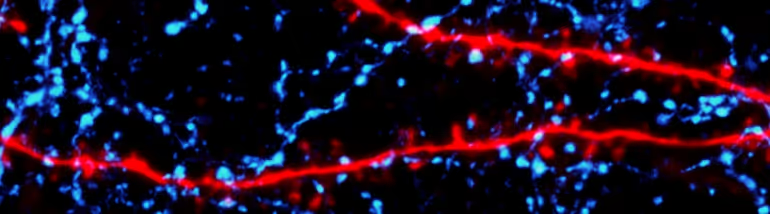
Synapses are the electrochemical junctions that support communication between neurons, and their activity forms the basis of signal propagation throughout the brain. We combine electrophysiology, multiphoton imaging, and optogenetics to study the structural and functional dynamics of synaptic transmission and identify principles of signal integration by individual neurons in the mammalian neocortex.

Vision allows us to recognize our friends, avoid danger, and navigate our surroundings. We investigate how neural circuits within the neocortex that encode visual information participate in the generation of sensory-guided behaviors. We also explore how dysfunction in these circuits contributes to cognitive and behavioral deficits in neurodevelopmental and neurodegenerative disorders.

Fluorescence imaging has revolutionized neuroscience with its ability to monitor neuronal structure and function across orders of spatial magnitude. Our lab applies and develops cutting-edge tools to measure transmitter release at single synapses, monitor cellular activity of multiple neuronal populations simultaneously, and quantify network dynamics across the neocortex in behaving animals.
The Higley Lab is committed to
breaking down boundaries in science, fostering collaborative projects that span different disciplines, and creating bridges between traditionally siloed communities.


